

Introduction: The Centralized World and the Quest for Autonomy
For centuries, the fundamental organization of human society has been defined by centralization. Whether examining ancient monarchies, modern banking systems, or today’s vast digital platforms run by a handful of tech giants, power, data, and decision-making authority have always flowed from a single, trusted entity at the top. This established structure provides order and efficiency, but it also creates profound vulnerabilities: these central points—a government, a bank, or a server farm—become single points of failure, susceptible to censorship, corruption, or catastrophic collapse. Whenever these institutions fail, whether through insolvency or abuse of power, the individuals relying on them bear the consequences without having any real recourse or control. The entirety of the traditional financial system and the initial phase of the internet, often called Web2, operates under this hierarchical, permissioned model, where user control is largely an illusion.
The invention of blockchain technology and its application in cryptocurrencies represents not just a technical innovation but a radical philosophical break from this centralized paradigm. At its heart, the movement seeks to build systems that operate without requiring trust in any human intermediary. Instead, trust is mathematically secured and distributed across a vast, independent network of participants. This approach aims to create a world where financial transactions, data storage, and digital identity management are self-sovereign, meaning they are controlled entirely by the individual user and governed by transparent, self-executing code.
Understanding this concept of decentralization is crucial because it is the single feature that gives cryptocurrencies and blockchain-based applications their revolutionary value proposition. It is the architectural blueprint for a more resilient, equitable, and censorship-resistant digital future. By removing the need for a central gatekeeper, these systems promise to democratize access to financial services, protect free exchange of information, and ultimately shift power back into the hands of the individual user. This shift is the driving force behind the entire crypto ecosystem.
Section 1: The Centralization Problem and Its Inherent Risks
Before appreciating decentralization, it is vital to clearly understand the inherent dangers and inefficiencies embedded within traditional centralized structures that the blockchain seeks to solve. These risks affect everyone, from individual users to massive global corporations.
Single Points of Failure
In a centralized system, all essential data and control mechanisms reside on a limited number of servers or are managed by a small governing body. If this central point is compromised, attacked, or simply fails, the entire system collapses instantly. This lack of redundancy is a massive liability.
A. Technical Vulnerability: A centralized server hosting a platform can be brought down by a denial-of-service (DDoS) attack or a hardware failure, immediately disrupting services for all users worldwide.
B. Custodial Risk: Banks and traditional financial institutions act as custodians of client funds. If the institution becomes insolvent or is compromised by internal fraud, customer assets are immediately placed at risk.
C. Data Silos: Large centralized tech companies hold massive, valuable troves of user data in centralized silos, making them prime, attractive targets for sophisticated external hacking groups.
The Risk of Censorship and Exclusion
Central authorities possess the absolute power to determine who can participate in the system and under what conditions. This is often framed as necessary for security, but it also enables unjust exclusion and arbitrary censorship.
A. Financial Exclusion: Governments or banks can unilaterally freeze accounts, block payments, or prevent individuals from accessing financial services, often based on political decisions or sanctions.
B. Content Censorship: Centralized social media platforms or hosting services can unilaterally delete user content, ban accounts, or suppress information, controlling the public narrative without transparency.
C. Permissioned Access: Traditional systems often require extensive documentation, often excluding millions of people globally who lack formal identification or live in unstable regions.
Lack of Transparency and Trust
Centralized systems operate within a “black box” where users must blindly trust that the governing entity is acting honestly and managing funds responsibly. This lack of visibility breeds mistrust and allows for hidden risks.
A. Opaque Reserves: Banks and financial institutions do not always provide real-time, public proof of their reserves, requiring users to rely on audits which may be delayed or flawed.
B. Hidden Policies: Changes to platform policies, algorithms, or terms of service are often implemented without genuine consultation or transparency with the user base, leading to arbitrary changes.
C. Unavoidable Trust: Every interaction requires trust—trust in the bank, trust in the government, and trust in the platform—a reliance that history repeatedly shows is often misplaced.
Section 2: Technical Implementation: The Distributed Network
The blockchain achieves decentralization by leveraging a distributed ledger architecture, fundamentally altering where data is stored, validated, and controlled. This distribution is the core technological solution to the centralized problem.
The Peer-to-Peer (P2P) Structure
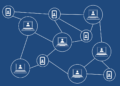
Unlike a traditional client-server model where all users connect to one central hub, a decentralized network is structured as a P2P network. Every participant is a node, capable of communicating directly with every other node, creating a web of interconnected computers.
A. Direct Communication: Transactions are broadcast across the entire network immediately, rather than being routed through a single central server that could be throttled or censored.
B. No Hierarchy: No single node has special authority or privileges over another. All nodes adhere to the same pre-established consensus rules defined by the protocol’s code.
C. Network Longevity: The failure of any single node, or even hundreds of nodes, has virtually no impact on the overall function or integrity of the network, ensuring incredible resilience.
Full Nodes as Arbiters of Truth
The integrity of the decentralized ledger is maintained by thousands of independent full nodes operating worldwide. These nodes are the network’s most critical components for maintaining truth.
A. Storing the Entire History: Every full node downloads, stores, and constantly verifies a complete, byte-for-byte copy of the entire blockchain’s history, from the first block to the very last.
B. Independent Verification: When a new block is proposed by a miner or validator, full nodes independently check every single transaction and cryptographic signature to ensure it complies with all network rules. They do not rely on a central party’s approval.
C. Immediate Rejection of Fraud: If a proposed block contains a fraudulent or invalid transaction, the full nodes will simply reject it and refuse to add it to their copy of the chain. Consensus is only achieved when the majority of nodes accept the block.
Byzantine Fault Tolerance (BFT)
The successful operation of a decentralized system in the presence of faulty or even openly malicious actors is mathematically guaranteed by the principle of Byzantine Fault Tolerance (BFT). This is a critical computer science concept essential to the viability of blockchain.
A. The Byzantine Generals Problem: This classic thought experiment addresses how a group of decentralized leaders can agree on a unified action if some members might be traitors.
B. PoW/PoS as BFT Solutions: Proof-of-Work and Proof-of-Stake are effectively economic mechanisms designed to solve the BFT problem by making it economically or computationally impossible for the malicious actors (the “Byzantine generals”) to gain the necessary control (the 51% attack) to corrupt the shared ledger.
Section 3: Distribution of Power and Governance

Decentralization extends far beyond the technical storage of data; it profoundly affects how decisions are made and how the system’s future evolution is determined. This is known as on-chain governance.
Protocol Development and Consensus
Unlike a centralized software company, which can issue a mandatory update overnight, changes to a decentralized protocol must be agreed upon by the vast majority of the community—a difficult and often contentious process.
A. Code Openness: The protocol’s source code is typically open-source, allowing anyone to audit it for flaws or propose improvements, maintaining transparency.
B. The Hard Fork Mechanism: Major, non-backwards-compatible changes to the core rules require a “hard fork.” This means users must voluntarily choose to upgrade their software to follow the new rules, demonstrating a true democratic consensus.
C. Economic Voting: Participants (miners, validators, or large stakeholders) often vote with their economic power, supporting the version of the chain that they believe will be the most secure and valuable in the long run.
Decentralized Autonomous Organizations (DAOs)
The most advanced expression of decentralized governance is the Decentralized Autonomous Organization (DAO). DAOs are organizations structured and run entirely by code and community rule, removing the need for traditional executives and boards of directors.
A. Governance Tokens: Members hold specialized tokens that grant them proportional voting power over key decisions, such as allocating funds or changing platform parameters.
B. Transparent Treasury: A DAO’s funds are held in a smart contract-controlled treasury, which is viewable on the public ledger. Spending proposals must be voted on and approved by the token holders.
C. Rule Enforcement: The rules of the DAO are written directly into smart contracts. Once a vote passes, the code automatically executes the decision, eliminating human error or deceit in implementation.
Section 4: Economic and Social Consequences of Decentralization
The shift away from centralized control has profound consequences that reshape economic behavior, market trust, and personal liberties. These impacts define the value proposition of the entire crypto space.
Censorship Resistance and Free Exchange
Decentralized networks are built to be maximally resistant to external interference. This feature is particularly valuable in contexts where freedom of speech or financial access is threatened.
A. Global Accessibility: Since participation requires only an internet connection and the software, people in politically restrictive or economically isolated regions gain access to a global, permissionless system.
B. Protecting Dissent: Activists, journalists, and dissidents can raise funds and communicate without the fear that their accounts will be frozen or their platforms shut down by hostile regimes.
C. Immutable Records: Once data is recorded on the decentralized ledger, no court order, government decree, or corporate decision can force its deletion or alteration, protecting the historical record.
Trustless Operation and Transparency
The decentralized nature of the ledger allows participants to interact and transact without having to rely on any third party for verification. This system relies on verifiable math, not human trust.
A. Public Auditability: The entire transaction history of the blockchain is publicly auditable by anyone in the world, ensuring that the monetary supply and all account balances are transparently verifiable at any moment.
B. Eliminating Counterparty Risk: In DeFi (Decentralized Finance), interactions are governed by smart contracts, removing the counterparty risk associated with traditional contracts that rely on legal systems and human enforcement.
C. Minimizing Corruption: By automating financial flows through transparent, self-executing code, the opportunities for personal kickbacks, insider trading, and hidden manipulation are significantly reduced.
The Creation of New Economic Systems
Decentralization is the foundation for creating entirely new economic models that challenge traditional corporate structures and wealth distribution. The shift to Web3 is fundamentally about creating a fairer internet economy.
A. Data Sovereignty: Users control their own identity and data on the network. They can choose to monetize their data or withhold it entirely, reversing the Web2 model where platforms profit from user data.
B. Platform Ownership: Through DAOs and governance tokens, users often become partial owners of the platforms they use, allowing them to benefit directly from the platform’s success rather than just being consumers.
C. Micro-Payments and Inclusion: The absence of expensive intermediary fees makes it feasible to conduct micro-payments and tiny transactions globally, opening up economic activity to millions previously excluded by high banking costs.
Section 5: The Current Limitations of Decentralization
While the philosophical goal is absolute decentralization, the reality is that the technology often involves trade-offs and current limitations that must be addressed for mainstream adoption. The pursuit of perfect decentralization is a continuous process.
The Scalability Trilemma Revisited
As mentioned previously, there is an ongoing technical challenge known as the Scalability Trilemma. Achieving maximum decentralization and security often requires sacrificing speed and efficiency. Large, highly decentralized chains are often slow and expensive to use.
A. Solution Fragmentation: The effort to improve scalability has led to a fragmentation of solutions, including Layer 2 networks (like rollups) and sidechains, which themselves introduce varying levels of centralization risk.
B. Network Congestion: During periods of high demand, the limited capacity of fully decentralized chains leads to severe congestion, resulting in unpredictable and often prohibitively high transaction fees.
C. The Need for Bridging: Moving assets between different chains or Layer 2 solutions requires complex bridging mechanisms, which have proven to be vulnerable to significant security exploits due to the difficulty of maintaining decentralization across multiple protocols.
Centralization Risks in the Infrastructure Layer
True decentralization can be undermined if the underlying infrastructure relies on centralized services. The technology stack itself often contains weak points that introduce centralization risk.
A. Cloud Hosting: A large portion of full nodes and network infrastructure often rely on centralized cloud service providers (like Amazon Web Services or Google Cloud), creating a potential bottleneck.
B. Development Teams: While the protocol is open-source, the core development and maintenance are often handled by small, influential teams, whose decisions and priorities can exert outsized influence over the network’s direction.
C. Wallet and Interface Layer: The vast majority of users interact with the decentralized network through user-friendly, centralized interface applications (wallets, exchanges), which act as choke points and potential targets for regulation or attack.
The Economic Centralization of Wealth
In many PoS and DAO systems, voting power and influence are tied to the amount of tokens or currency staked. This leads to a form of economic centralization, where a small number of early adopters or whales (large holders) hold disproportionate influence over the system’s governance and direction. The principle of one-person, one-vote is replaced by one-token, one-vote.
A. Governance Capture: Large holders can coordinate to vote in their own economic interest, potentially overriding the desires of the broader community.
B. Staking Pool Concentration: In PoS systems, large, specialized staking pools can accumulate significant percentages of the total stake, increasing their influence on block validation and potentially threatening network stability if they collude.
C. Barrier to Entry: While accessible, the economic barrier to becoming a significant validator in some PoS systems can be very high, further reinforcing economic centralization at the top layer.
Conclusion: The Continuous Pursuit of Peer-to-Peer Systems

Decentralization is more than a technical feature; it represents a profound, necessary philosophical commitment to building digital systems that prioritize resilience, transparency, and individual autonomy over corporate or government control. By rejecting the centralized model, blockchain creates truly trustless, self-verifying, and censorship-resistant ledgers.
The foundational design relies on cryptographic hashing and a peer-to-peer network to eliminate the need for any single, fallible intermediary.
The system’s resilience is guaranteed by the distributed nature of its data and the economic disincentives designed to prevent malicious action by any single actor.
Decentralization enables true censorship resistance, ensuring that individuals globally can transact and communicate without fear of arbitrary exclusion or blockage.
The rise of DAOs showcases the potential for fully automated, transparent governance structures that move decision-making power to the collective community.
While technical challenges like the Scalability Trilemma introduce ongoing trade-offs, they motivate continuous innovation toward more efficient and robust decentralized solutions.
Ultimately, the quest for robust decentralization defines the enduring promise of a Web3 future where technology empowers the individual rather than the institution.